
Every home has a spot where children naturally drift when they need a break. Behind the sofa. Under the dining table. Inside a closet with a flashlight.
A quiet corner is simply that instinct, made official. A small, cozy place where a child can go to slow down, color, look at books or just sit.
Done well, it's one of the most used spots in the house. Done badly, it's a beanbag nobody sits on. Here's how to make it the first kind.
Why a quiet corner is not a time-out
This is the one rule that makes or breaks it. If the quiet corner is where you get sent when you're in trouble, it becomes a punishment spot, and nobody wants to go there voluntarily.
Instead, it's a place children choose. "You look like you need a break. Want to go to your cozy corner for a bit?" is an invitation. "Go to your corner!" is a sentence. Keep it an invitation.
It also doesn't need to be only for big feelings. Children should use it when they're happy too, to read, color or daydream. That way, it feels like a nice place rather than a sad one.
Where to put it
- Close enough to you that it doesn't feel like being sent away. A corner of the living room is often better than a bedroom.
- A little enclosed: beside a bookshelf, under a loft bed, behind a curtain or inside a play tent.
- Away from the TV and busy walkways.
- Soft light: a small lamp or string lights (well out of reach).
No room? A big floor cushion and a basket that lives in a corner is enough. It's the ritual, not the square footage.
What to put in a quiet corner
Keep it light. A packed corner is overwhelming. The best ones have just a few inviting things in view.
A simple quiet-corner coloring kit
Everything below works on Meowelo pages. Start with one; you can always add later.
- Crayola Large Crayons, Lift-Lid Box, 16 Count The step up from the 8-count: the same easy-grip size with twice the colors and a box that actually closes. Check price on Amazon
- Crayola Erasable Colored Pencils for Kids, 24 Count The best colored pencils for cautious or perfectionist kids: mistakes rub out, so starting feels easier. Check price on Amazon
- Learning Resources Create-a-Space Storage Center A sturdy tabletop storage caddy that keeps crayons, markers and pencils sorted and within reach. Check price on Amazon



How to introduce it
- Build it together on a calm day. Let your child choose the cushion, the books, the name. ("The Den." "Lantern Corner." "Pico's Place.")
- Explain what it's for: "This is a spot you can go when you want some quiet time. You can go whenever you like."
- Practice when calm. Spend a few minutes there together reading or coloring.
- Use it yourself. "I'm going to sit in the cozy corner for five minutes with my tea." Modeling matters more than any explanation.
- Offer it gently in bigger moments: "Do you want to go to the Den for a bit? I can come too, or you can go on your own."
An independent play space for a six-year-old
By around six, many children can use a quiet corner on their own for twenty minutes or more, which is a gift for everyone. A few tips help it become an independent play habit:
- Everything within reach, so they don't need to call you for help.
- Open-ended activities like story coloring, simple puzzles and drawing prompts, not activities that need a grown-up.
- A predictable "quiet time" slot, like after lunch on weekends.
- A clear end signal: a timer, or "when the song finishes".
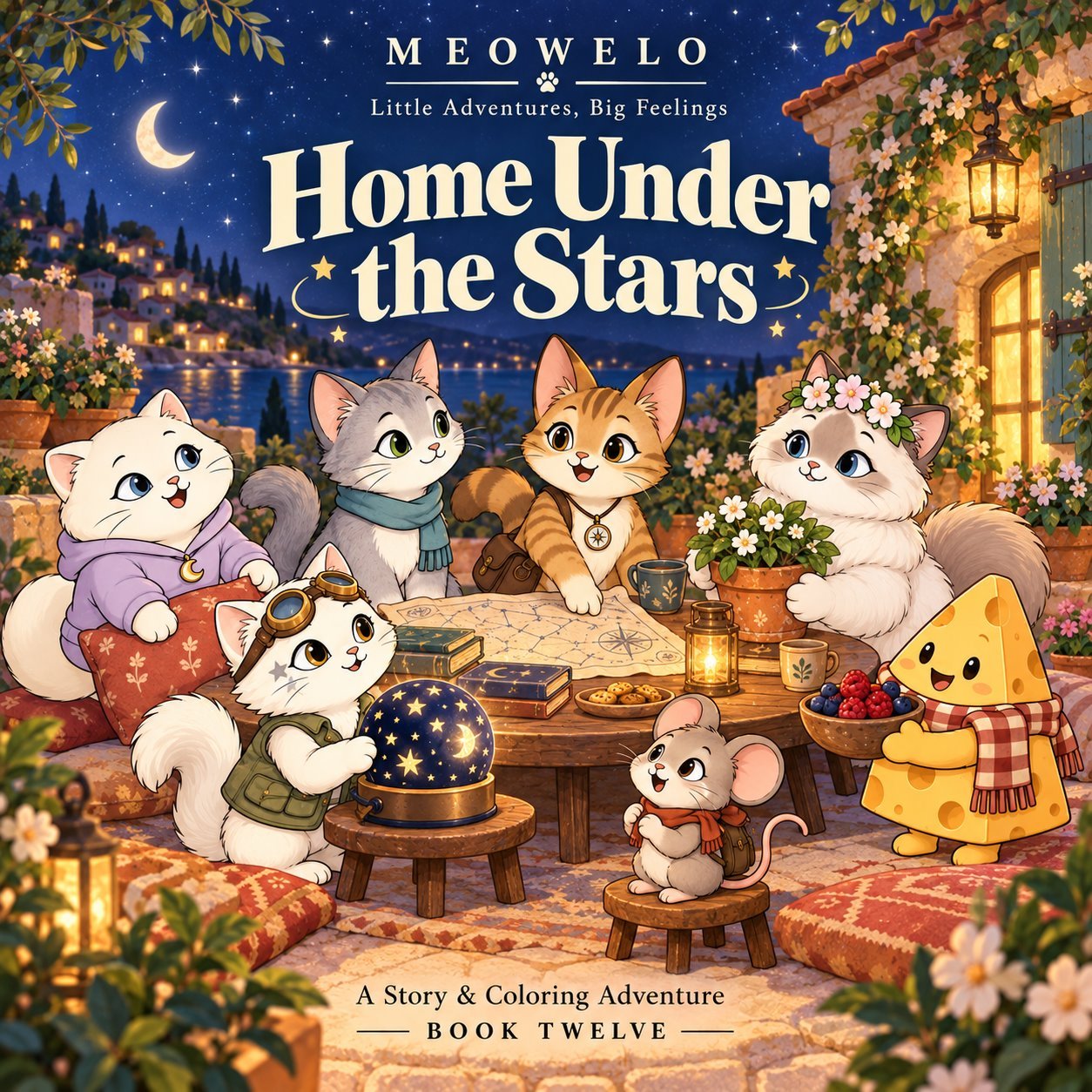
Home Under the Stars
With Lunai, Riyu, Myro, Naeli, Rinwa, Pico & Cheddo · Ages 6–10 · Story + coloring
There is room for you here.
There's a reason Home Under the Stars, the final Meowelo book, includes a character who wants "a quiet corner". When seven friends gather for an evening, some want to talk and some want space, and the story treats both as completely fine. It's a lovely one to keep in the corner itself.
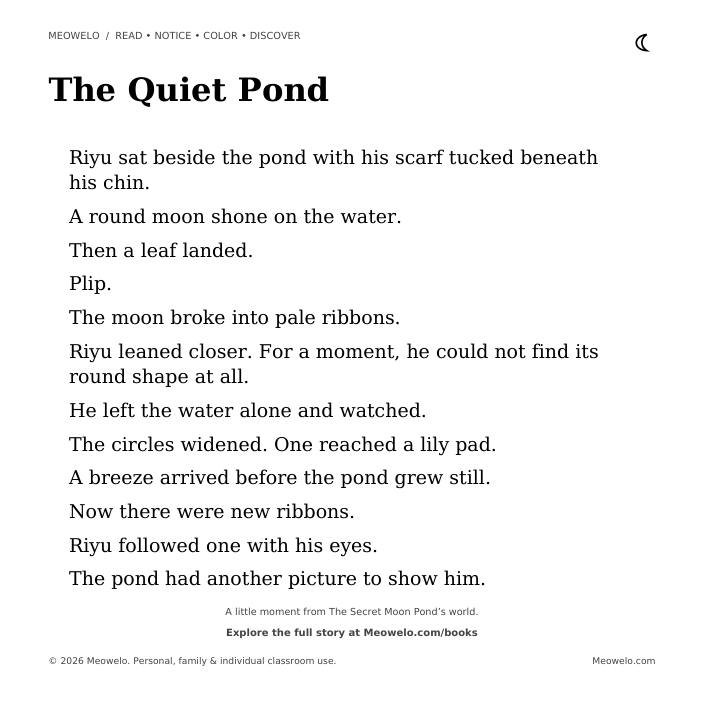
The Quiet Pond
Riyu watches the pond after a leaf lands. A free two-page story and coloring scene, made for quiet corners.
Print it freeKeeping it working
- Rotate the contents every week or two so there's something new to discover.
- Don't follow them in with questions. If your child takes themselves there, let them be.
- Check in afterwards, lightly: "That looked like a nice break. Feel better?"
- Protect it. Siblings can have their own spot, or take turns.
Questions parents ask
What age is a quiet corner good for?
Is a quiet corner the same as a calm-down corner?
What if my child never uses it?
A small place that says "you can rest here"
A quiet corner doesn't need to be beautiful or big. It needs to be soft, predictable and freely chosen. Build it together, use it together, and let it become one of those places your child remembers.

The Secret Moon Pond
Where did the moon go?
“Riyu and Rinwa find the moon shining on a secret pond. Then a leaf falls, and the round reflection disappears.”
With Riyu & Rinwa · Ages 6–10 · Story + coloring