The story
Rain taps at Lunai's window. Somewhere out in the dark lane, a small light is moving, bobbing past the flower shop and the three lanterns he knows by heart. Lunai watches it. His tummy flutters, and his mind is already halfway to an answer: something might be out there.
But Lunai is a noticer. So he looks again, slowly. The lane is the same lane. The lanterns are the same lanterns. There is one light he doesn't recognize, and that is all he actually knows. With a very small mouse named Pico beside him and one little next step to take, Lunai opens the door to find out.
What he finds is not the thing he imagined. It rarely is. And even then, his tummy is still a little fluttery, which the story lets be perfectly fine.
What it quietly practices
Children are wonderful at filling in the unknown, and sometimes they fill it with something scary. Lunai and the Quiet Moon shows a gentle alternative without ever saying "don't worry": sorting what you know from what your mind is guessing, then choosing one small, safe step to learn more.
Nobody in the story tells Lunai to be brave. He isn't brave in a loud way. He's quietly curious, and that turns out to be enough. Children who hear this pattern often start borrowing the question themselves: "What do I know? What am I guessing?" We wrote more about it in The Question That Shrinks Big Worries.
Great for
- Children who ask "but what if...?"
- Cautious, thoughtful kids
- Rainy evenings and bedtime
- The first book in the series
- Ages 6 to 10, and younger siblings who color along
Inside the pages
Every spread pairs a short page of story with the same moment drawn as a coloring scene: the rainy window, the wet lane, the lanterns, the doorway. The artwork uses ultra-bold outlines and wide, open shapes that are satisfying with crayons and colored pencils, and forgiving for younger hands.
The book's own palette is moon blue, deep navy and warm lantern gold, but that's only a suggestion. A pink moon or a green Lunai is just as welcome. We never tell children which color to use.
Reading it together
Read one spread, then pause over the picture before anyone picks up a crayon. That small pause is the heart of the Read, Notice, Color rhythm. You don't need to explain the idea behind the story. Let the questions do the work, and let silence be an answer too.
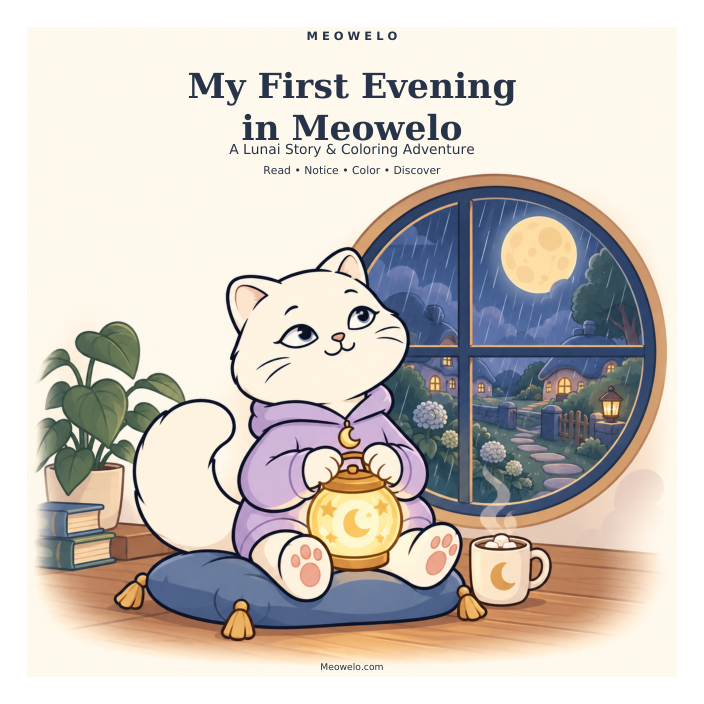
My First Evening in Meowelo
Try Lunai's world first: a free ten-page mini adventure with story pages, coloring scenes and one gentle question.
Print it free| Series | Meowelo Story & Coloring Collection, Book 1 of 12 |
|---|---|
| Theme | Safety |
| Quietly practices | Telling a thought apart from a fact, and taking one small step while still unsure |
| Characters | Lunai, Pico |
| Ages | 6–10 (read together from six, alone from about eight) |
| Format | Paperback story-and-coloring book, printed and sold by Amazon |
| Layout | Story on the left page, the same moment to color on the right |
| Colors with | Crayons and colored pencils; markers with a spare sheet behind the page |
| This book's colors | (a suggestion only; every color choice is the child's) |
Where it fits in the series
Every Meowelo book is a complete story, so you can start anywhere. Read in order, the twelve books move from feeling safe, through growing, courage and change, to belonging. This is where the journey begins. See all twelve books in order.
Conversation
Families talking about this book
How it went at your house, and questions about the book. A person reads every comment before it goes live.
Be the first family to share how this book went, or ask us anything about it.