Count, some day, how many times you say "Good job!"
Good job putting your shoes on. Good job eating your peas. Good job on that drawing, that tower, that somersault, that bathroom trip. If you're anything like most parents, it's dozens. It comes out automatically, like "bless you" after a sneeze.
There's nothing terrible about it. But after a while, "good job" stops meaning very much, to you or to your child. And some kinds of praise, it turns out, can quietly make children less willing to try hard things.
This guide covers what research says about praise, the simple shift that makes it far more useful, and 50 ready-to-use phrases for art, effort, kindness, mistakes and that tricky moment when your child holds up a picture and asks, "Do you like it?"
Is saying "good job" actually bad?
No. Warmth and encouragement are good for children, and a cheerful "good job!" comes from a loving place. Nobody needs to feel guilty about it.
The trouble is simply that it's vague. It tells a child that you're pleased, but not what pleased you. Was it the colors? The effort? The fact that they finished? Without that information, the praise is nice but not very useful. It can also become background noise: said so often that children stop hearing it.
And there's one specific kind of praise that researchers have found can genuinely backfire.
What research says about praise
Praising intelligence vs. praising effort
In a well-known series of studies published in 1998, psychologists Claudia Mueller and Carol Dweck gave children a set of problems and then praised them in one of two ways. Some were praised for their ability ("You must be smart at these"). Others were praised for their effort ("You must have worked hard at these").
Afterwards, the children praised for being smart were more likely to choose easier tasks, seemingly to protect their "smart" label. When they later hit harder problems, they tended to enjoy them less and do less well. The children praised for effort were more willing to take on challenges and kept going when things got difficult.
This research is part of the foundation of what's now often called a growth mindset: the idea that abilities grow with effort, strategies and practice. The practical takeaway for parents is simple: praise what children do, not what they are.
The trouble with "over the top" praise
Other research, including a 2014 study by Eddie Brummelman and colleagues, found that inflated praise ("You made an incredibly beautiful drawing!") can make children who already have low confidence less likely to take on challenges afterwards. It seems to raise the bar so high that trying again feels risky.
Children are also very good at spotting praise that doesn't match reality. If every scribble is "the best drawing ever," the words lose their value, and some children stop trusting them.
The simple shift: from judging to noticing
Most helpful praise does one of five things. You don't need all five every time; just aim for one.
1. Describe what you see
Simply say out loud what your child did. It's powerful because it shows you really looked.
- "You colored the whole sky in stripes!"
- "You put your shoes on by yourself, even the tricky Velcro."
- "You built that tower taller than your knee!"
2. Notice effort and strategies
Point out how they did it: the trying, the practicing, the problem-solving.
- "You kept going even when that part was hard."
- "You tried a different way when the first one didn't work."
- "You practiced that every day this week, and look."
3. Notice choices
Especially for creative work, notice the decisions they made. It tells children their ideas matter.
- "You chose purple for the moon. Tell me about that."
- "You decided to leave that part white. Interesting!"
4. Notice kindness and character in action
Praise the specific kind thing, not a fixed trait. "You shared your crayons with your brother when he didn't have any" beats "You're such a good girl."
5. Ask, don't grade
Questions invite children to judge their own work, which builds far more lasting confidence than any grade from you.
- "Tell me about it."
- "Which part are you proudest of?"
- "What was the trickiest part?"
50 phrases to use instead of "good job"
Keep this list handy (the fridge is a good spot). You don't need to memorize it. After a week or two, noticing starts to feel natural.
For drawing and coloring
- "Tell me about your picture."
- "You used so many different colors!"
- "How did you decide which color to use here?"
- "You filled in that whole shape carefully."
- "I love how you made the sky dark and the lantern bright."
- "You spent a long time on those details."
- "You tried shading! How did you make it darker there?"
- "This part looks like it moves. How did you do that?"
- "What's happening in this picture?"
- "Which part do you like best?"
For effort and persistence
- "You kept trying, even when it was frustrating."
- "You didn't give up on that one."
- "You worked really hard on this."
- "You practiced, and now you can do it."
- "That took a lot of patience."
- "You tried a new way when the first way didn't work."
- "Remember when you couldn't do this? Look at you now."
- "You stuck with it for a long time."
- "You figured that out yourself."
- "You took your time and it shows."
For trying something new or scary
- "You were nervous and you tried anyway."
- "That was brand new, and you gave it a go."
- "You took the first step. That's often the hardest part."
- "You didn't know how it would go, and you tried it."
- "Trying tells us things thinking can't. What did you find out?"
For mistakes and "failures"
- "That didn't work the way you wanted. What will you try next?"
- "Now we know which part didn't work. That's useful."
- "It doesn't have to be perfect to be worth trying."
- "Mistakes are how we find out what to change."
- "You're disappointed. That makes sense. Want to try again later?"
- "That wobbly line could turn into something. What could it be?"
- "I make mistakes too. Here's one I made today..."
- "You tried something hard. That's worth more than getting it right first time."
For kindness and helping
- "You noticed your friend was sad and you sat with her."
- "You shared even though you really wanted it."
- "That was really helpful. Thank you for carrying that."
- "You made your brother laugh when he was upset."
- "You waited for your turn, even though it was hard."
- "How do you think she felt when you did that?"
For independence and responsibility
- "You got ready all by yourself!"
- "You remembered without me reminding you."
- "You tidied your crayons back into the box."
- "You made a plan and followed it."
- "You solved that problem on your own."
When they ask "Is it good?" or "Do you like it?"
- "What do you think of it?"
- "I love looking at it. Tell me about this part."
- "What are you proudest of?"
- "If you did another one, what would you try?"
- "I can see how much you enjoyed making it."
- "You should be proud of yourself. How does it feel?"
Swaps for the most common praise
Instead of
You're so smart!
Try
You worked out a clever way to solve that.
Instead of
Good job!
Try
You put all the blocks back in the box. Thank you!
Instead of
That's the most beautiful drawing ever!
Try
You used so many colors in the sky. Tell me about it.
Instead of
You're a natural artist!
Try
You've been practicing your drawing, and your lines are getting so steady.
Instead of
Good girl / good boy.
Try
You were really kind to share your crayons.
Instead of
See, I told you it was easy!
Try
That was tricky, and you figured it out.
How to praise children's art (without judging it)
Art is where praise gets especially tricky. Children pour themselves into drawings, and they're very sensitive to how grown-ups react. A few principles help:
- Get curious before you get complimentary. "Tell me about it" is the best opening line in the world.
- Don't guess what it is. "Is that a horse?" can crush a child who drew a dragon. Let them tell you.
- Notice choices, not quality. Colors, patterns, backgrounds, details: things they decided.
- Don't fix it. Resist the urge to "just add" something. It's theirs.
- Display it with care. A frame or a clip on a string says "this matters" more loudly than any words.
If your child has started saying "I can't draw," our guide to what to say when a child gives up on a picture goes deeper.
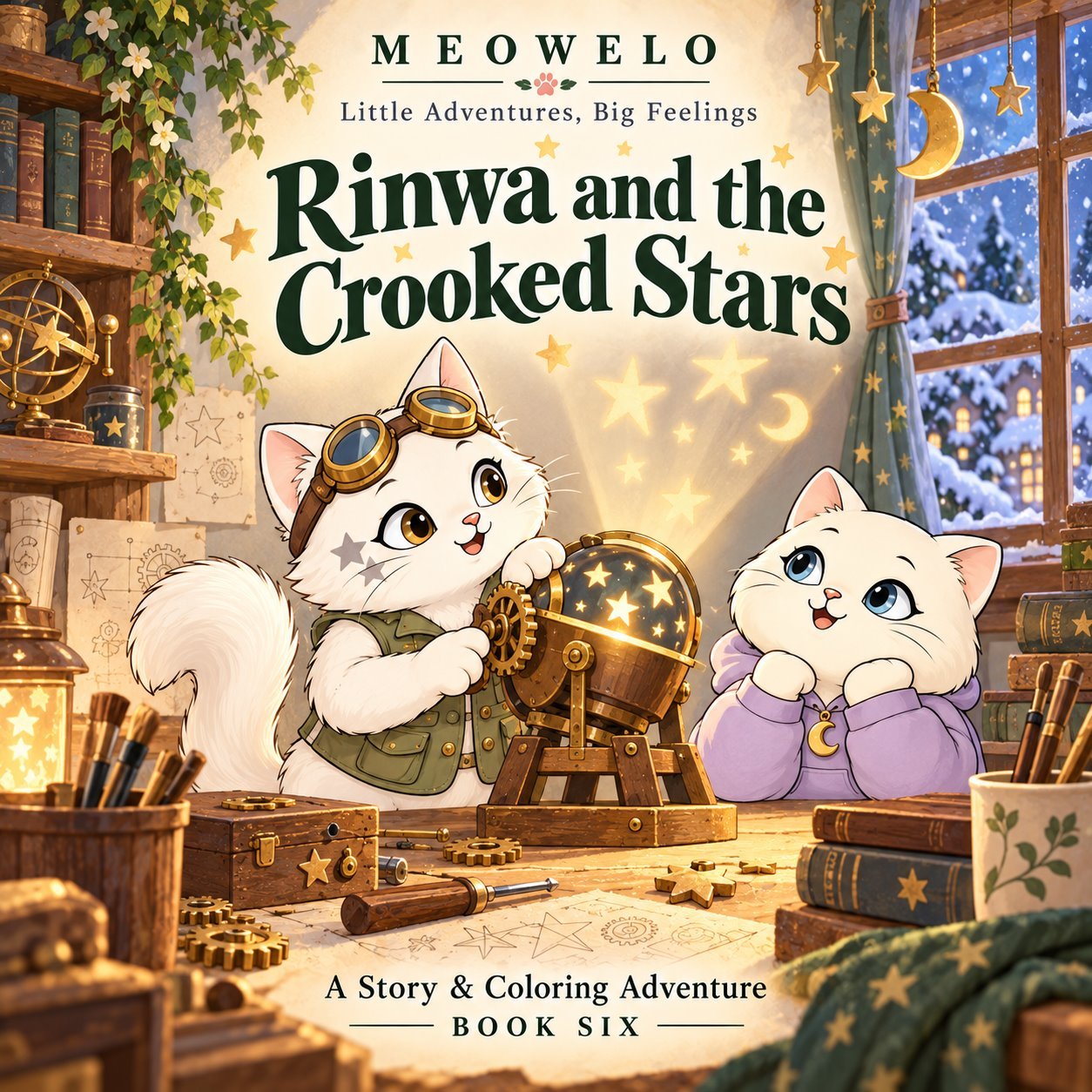
Notice what Myro doesn't do. He doesn't rush in with "It's fine! It was great anyway!" He waits, and Rinwa finds the useful part of the mistake herself. That quiet patience is its own kind of praise: it says "I trust you to work this out." In Rinwa and the Crooked Stars, her star projector goes wrong twice before it works, and the story never pretends that doesn't sting.
Rinwa and the Crooked Stars
With Rinwa & Lunai · Ages 6–10 · Story + coloring
The stars weren't supposed to look like that.
Praise at different ages
Ages 3 to 5
Young children love being seen. Describing what they're doing is praise in itself: "You're pouring the water all by yourself!" Keep it short, warm and concrete. They don't need a lecture about effort; they need to know you noticed.
- "You did it!" is fine, followed by one specific detail.
- Narrate their actions: "You put the red one on top, then the blue one."
- Celebrate trying, especially with new skills like dressing or pouring.
Ages 6 to 8
This is when children start comparing themselves to others, and when "I'm bad at this" can creep in. Process praise matters most now: it teaches that skills grow with practice.
- Link effort to progress: "Remember last month? You've been practicing."
- Name strategies: "You checked your work. That's what careful readers do."
- Be honest: "That was tricky" is more believable than "That was easy!"
Ages 9 to 10
Older children can smell empty praise from across the room. They want to be taken seriously. Specific, genuine and sometimes private praise works best, especially in front of friends.
- Ask for their opinion first: "What do you think worked?"
- Notice independence and responsibility: "You planned that whole project yourself."
- Praise quietly: a note in a lunchbox or a word at bedtime can mean more than a public cheer.
Praise and siblings
Praise lands differently when there's a sibling in the room. A few gentle rules help avoid a household ranking system:
- Never praise one child by comparison ("Why can't you color neatly like your sister?"). It hurts both of them.
- Avoid fixed family roles: "the artist," "the sporty one," "the clever one." Labels can stop siblings trying each other's things.
- Praise teamwork: "You two figured out how to share the markers. That was clever."
- Give each child one-on-one noticing time, even five minutes, where praise isn't a competition.
Praise yourself out loud (yes, really)
Children learn how to talk to themselves by listening to how we talk to ourselves. If they hear you say "Ugh, I'm so bad at this," they learn that script. If they hear "That didn't work. Let me try a different way," they learn that one instead.
- "I kept trying with that jar lid, and I got it!"
- "I made a mistake in the recipe. Now I know to measure first."
- "I was nervous about that phone call, and I did it anyway."
It feels a little silly at first. Children don't mind. They're listening.
Is it okay to say "I'm proud of you"?
Yes, absolutely. Children love hearing it. You can make it even more powerful by adding the why and turning the spotlight back to them:
- "I'm proud of you for sticking with that."
- "You should be proud of yourself. You worked so hard."
- "How do you feel about it?"
The long-term goal is for children to feel proud of themselves, not just to seek pride from others.
What about stickers, charts and rewards?
Reward charts can help with specific habits, like a new bedtime routine. But if every creative act comes with a sticker, children can start drawing for the sticker, and enjoy drawing less when it stops. For art and play, the reward is best left inside the activity itself: the fun of making something, and a grown-up who's genuinely interested.
Common praise mistakes (and gentle fixes)
- Praising only results. Fix: notice effort and strategies too, especially when results aren't there yet.
- Labeling children ("the artistic one," "the smart one"). Fix: describe actions, not identities. Labels can box siblings in.
- Praising easy things lavishly. Fix: save your enthusiasm for real effort. Children know when something was easy.
- Comparing ("Better than your sister's!"). Fix: compare them only to their past self.
- Adding a "but" ("Great drawing, but you went outside the lines"). Fix: let praise stand on its own. Feedback can come another time, if at all.
- Praising while distracted. Fix: put the phone down, look, and say one specific thing. Ten real seconds beat ten automatic "good jobs."
Try this for one week
You'll probably notice two things. First, your praise will feel more real to you. Second, your child will start describing their own effort: "I kept trying!" That's the whole goal.
Questions parents ask
What should I say instead of "good job"?
Why shouldn't I tell my child they're smart?
Is too much praise bad for kids?
How do I praise my child's drawing?
What is process praise?
Is it okay to say "I'm proud of you"?
Notice more, judge less
You don't need to banish "good job" from your vocabulary. Just try, a few times a day, to swap it for something that shows you really saw: the effort, the choice, the kindness, the brave first try. Children grow into the things we notice. Notice the trying.
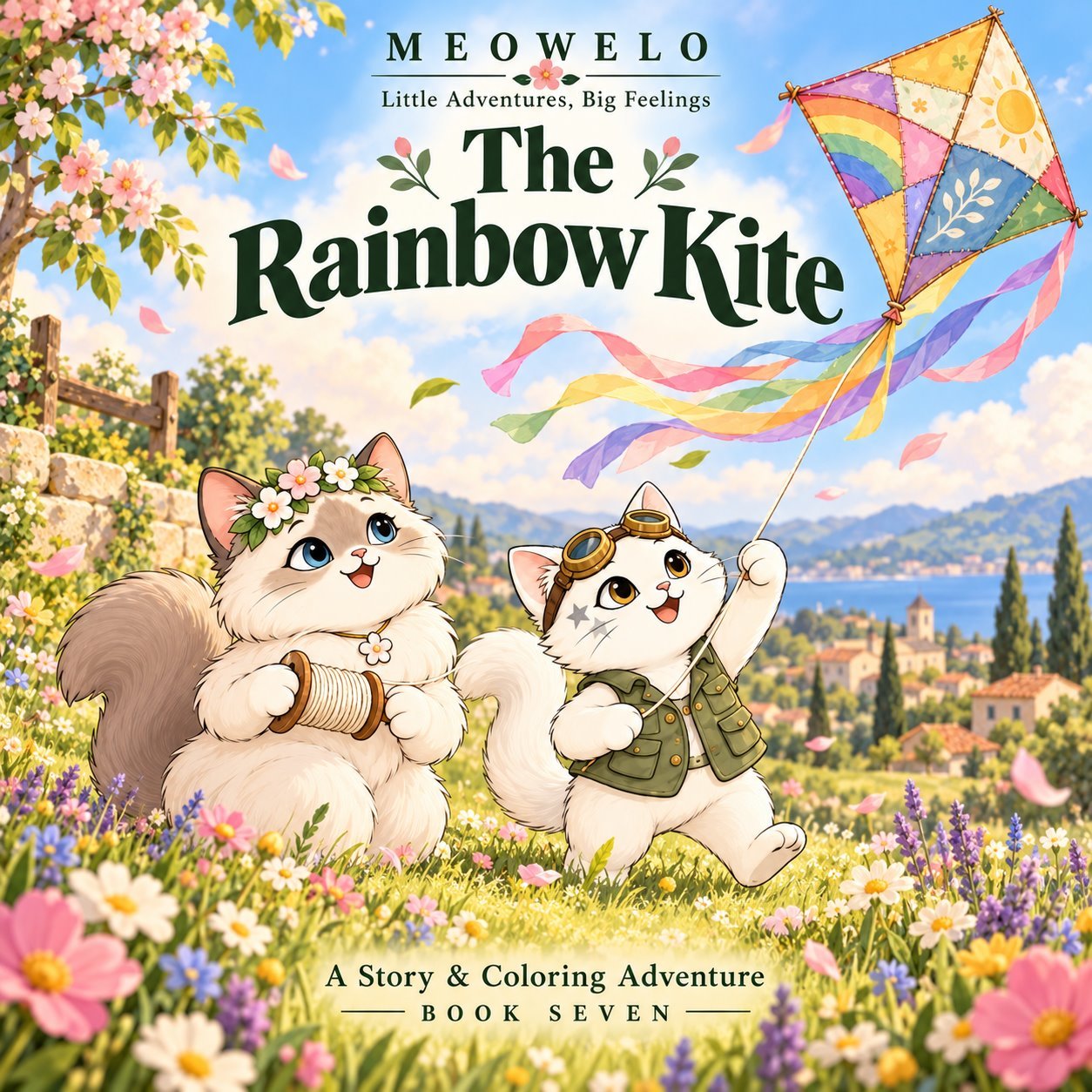
The Rainbow Kite
Their kite has a few surprises in store.
“What goes up in the end is not the kite on the plan. It's better, and neither of them would have thought of it on purpose.”
With Naeli & Rinwa · Ages 6–10 · Story + coloring