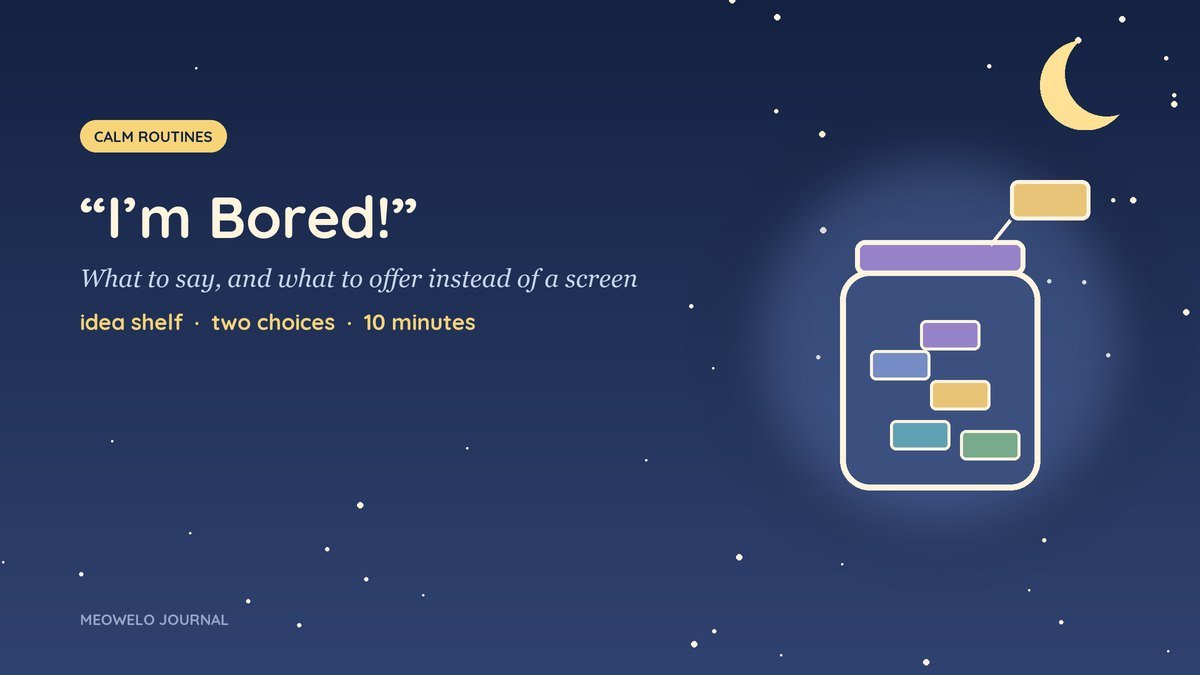
When a child says "I'm bored", the most useful answer is usually not a list of activities but a calm "Hmm, what could you make with that?" and a few ready-made options they can choose from on their own. "I'm bored" often means "I don't know how to start". If a grown-up always fills the gap, the child never practices starting. If there are a few easy things within reach and a little patience, many children find their own way into play within ten minutes.
Below: what to say (and skip), a simple setup that makes "bored" less frequent, ideas that need no preparation, and when boredom is something else.
What "I'm bored" usually means
- "I don't know how to start." The most common one. Too many options, or none visible.
- "I want you." Sometimes it's a request for company, not entertainment.
- "I just stopped something exciting." After a screen or a busy outing, everything else feels slow for a while.
- "I'm tired or hungry." Worth checking before anything else.
Unstructured time, when nothing is planned, is where a lot of children's play and imagination happens. The American Academy of Pediatrics' report on play describes how much children gain from free play they direct themselves. Boredom is often the uncomfortable doorway into it.
What to say (and skip)
Instead of
Go and find something to do.
Try
Hmm. Want to pick something from the idea shelf, or shall we look together?
Instead of
You have so many toys, how can you be bored?
Try
It's hard to start sometimes. What did you enjoy last time?
Instead of
Fine, have the tablet.
Try
Let's set a timer for ten minutes and see what you come up with. I'll check back.
Offering two choices ("drawing or building?") works better than a long list. And sometimes the best answer is two minutes of your company: sit down, start something yourself, and let them join.
Set it up in advance: the idea shelf
A little preparation on a calm day means fewer "I'm bored"s on busy ones:
- An idea shelf or basket at child height with five or six things that need no help: paper and crayons, a building set, a book of puzzles, a printed coloring page, playdough, a deck of cards.
- A boredom jar: write simple ideas on slips of paper together ("build a den for a toy", "draw your dream house", "invent a new animal"). When bored, pull one out.
- Rotate the shelf every week or two so something always feels new.
- Keep it visible. Options in a closed cupboard don't exist for a bored child.
Ideas that need no preparation
| If they want to… | Try |
|---|---|
| Make something | Draw a map of an imaginary island; color a page in only three colors; design a new board game |
| Move | An obstacle course with cushions; a treasure hunt for five red things |
| Be quiet | A short story read aloud and a page to color; a jigsaw; a den with a torch and a book |
| Be with someone | Help cook dinner; write a letter or draw a card for a grandparent |
More screen-free ideas are in our rainy-day activities, and if the "bored" comes right after a screen, our guide to ending screen time without a meltdown covers that bumpy changeover.
A ten-minute rule
Many families find this helps: when a child says "I'm bored", agree a short time (ten minutes) to find something themselves, with the idea shelf within reach. If they're still stuck after that, sit down together for a couple of minutes to get them started. Children learn they can get through the uncomfortable bit, and usually don't need the second step.
When "bored" is something else
If a child is "bored" with everything for a long stretch, stops enjoying things they used to love, or seems sad or withdrawn, it's worth talking with them gently and, if it continues, mentioning it to their doctor or teacher. Ordinary boredom comes and goes; this is different.
A story and a page to color
One easy option for the idea shelf: a short Meowelo story moment and its picture to color. It's a calm, ten-minute activity a child can start on their own, with or without a grown-up reading along.

The Meowelo Companion
The free Meowelo Companion is a 40-page guide for grown-ups on reading and coloring together. Plus 10 printable gifts for subscribers.
Get the free guideQuestions parents ask
What should I say when my child says "I'm bored"?
Is it OK for kids to be bored?
What is a boredom jar?
How do I stop my child asking for screens when bored?
When is boredom a sign of something else?
The one thing to remember
"I'm bored" is rarely a problem to solve for them. Keep a few good things within reach, offer two choices and a little patience, and give them the chance to discover what they want to do next.


Conversation
Join the conversation
Tips, questions and stories from other grown-ups. A person reads every comment before it goes live.
No comments yet. What has worked at your house? Your story might be exactly what another parent needs tonight.