A good story prompt for children is a small, surprising situation they can picture straight away, like "You find a door in a tree that wasn't there yesterday." Children who find writing hard often find drawing easy, so the best prompts work both ways: draw the moment first, then tell or write what happens next. Here are thirty to start with.
Below: the prompts in four groups, and three ways to use them.
What if…
- What if your shadow decided to go on its own adventure?
- What if it rained a different color every day?
- What if your pet could talk for one hour only?
- What if every lantern on your street held a tiny message?
- What if you could shrink to the size of a mouse for a day?
- What if the moon fell into your garden pond?
- What if your drawings came alive at night?
- What if you found a map of your own house with an X on it?
Mysteries
- Footprints lead from the window to the cookie jar. Whose are they?
- A kite gets stuck in a tree, and it's holding a letter.
- Every morning, one more flower has appeared in the garden.
- Someone keeps leaving acorns on the doorstep.
- The town clock has stopped at the same time every night.
- A small light flickers in the woods. What is it?
- A box arrives with your name on it and nothing inside except a key.
Tiny worlds
- Design a home inside a hollow tree. What's in each room?
- A city on the back of a giant, sleepy turtle.
- The ants under the picnic blanket are having their own picnic.
- A school for baby clouds.
- A hidden village inside a sunflower.
- A bakery run by hedgehogs.
- A library where the books choose the readers.
Adventures
- You and a friend have to cross a river with only what's in your pockets.
- A storm blows your treehouse to a new place.
- You're the only one who can climb to the top of the tallest hill.
- The lanterns have gone out along the path home.
- You build a boat out of something surprising.
- A snow day turns into a snow week.
- You find a door at the bottom of the garden.
- Seven friends set off to find the first star of the evening.
Three ways to use them
| Way | How | Good for |
|---|---|---|
| One drawing | Draw the moment, then tell it out loud | Ages 6+, reluctant writers |
| Beginning, middle, end | Three boxes: three drawings, one line each | Ages 7+ |
| A comic | Six panels with speech bubbles | Ages 9+ |
For children who find reading and writing a struggle, starting with a picture takes the pressure off. See helping reluctant readers and coloring and reading.
Instead of
That doesn't make sense.
Try
Ooh, then what happened? Show me in the next picture.
Story prompts are a perfect fit for family story night, and for those "I'm bored" moments (see what to say when they're bored).
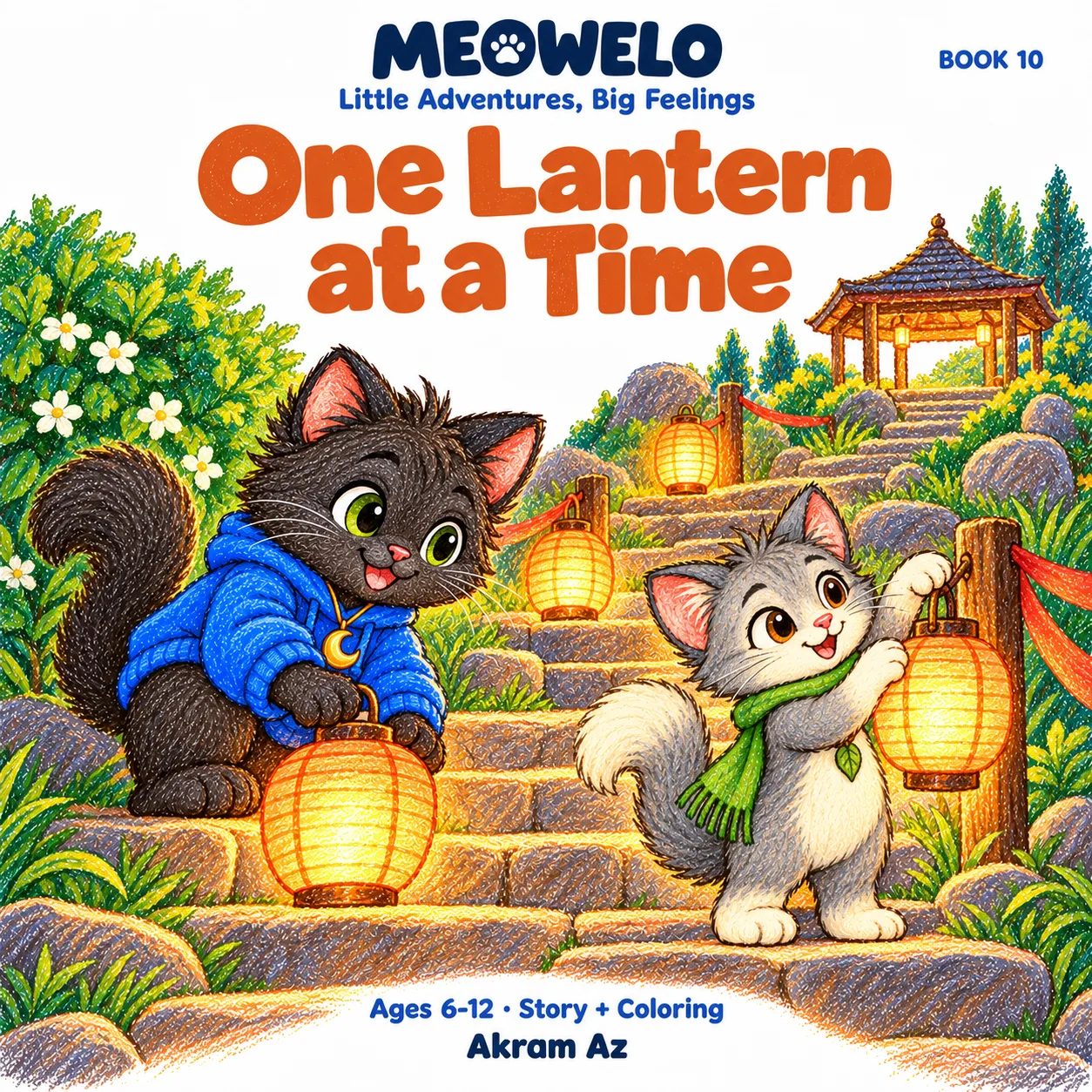
One Lantern at a Time
A lantern walk that turns out longer than anyone expected.
“There is so much to prepare, and the way ahead looks long. Which little lantern will they choose next?”
With Lunai, Myro, Riyu, Naeli, Rinwa, Pico & Cheddo · Ages 6–12 · Story + coloring
Help a stuck storyteller
| If your child says… | Try |
|---|---|
| "I don't know what to write." | "Draw it first. Then tell me what's happening." |
| "It's boring." | "What's the most surprising thing that could happen next?" |
| "I can't think of an ending." | "How would your character feel at the end? Start there." |
| "It's too long." | "Three boxes: beginning, middle, end. That's a whole story." |
Build a story in five questions
- Who? One character, with one thing they love.
- Where? One place, with one interesting detail.
- What goes wrong? One small problem.
- What do they try? One or two attempts, maybe with a friend's help.
- How does it end? Solved, or not, but changed.
Answering these five out loud is often enough for a child to have a complete story before writing a word.
A prompt jar
Write the thirty prompts on slips of paper and keep them in a jar. Pull one out for family story night, a rainy afternoon or a long car journey. Children can add their own prompts to the jar too, which quickly becomes the most popular part.
Keep their stories
Save their stories in a folder or notebook. Rereading their own ideas a year later is often a child's favorite part.
A story notebook also works as a quiet record of how a child's imagination grows: early stories are often one long sentence with a drawing, later ones have problems, twists and dialogue. Leave space under each story for the date and their age. Children love comparing their stories from different years, and the notebook often becomes one of the things families keep longest, alongside favorite drawings. Some families even bind a year of stories into a small book as a birthday gift.
Questions parents ask
What are good story prompts for kids?
How do you use story prompts with kids who don't like writing?
What age are these story prompts for?
Can story prompts be used in a group?
The one thing to remember
Every story starts with one picture in your head. Pick a prompt, draw that picture, and ask "then what?"


Conversation
Join the conversation
Tips, questions and stories from other grown-ups. A person reads every comment before it goes live.
No comments yet. What has worked at your house? Your story might be exactly what another parent needs tonight.