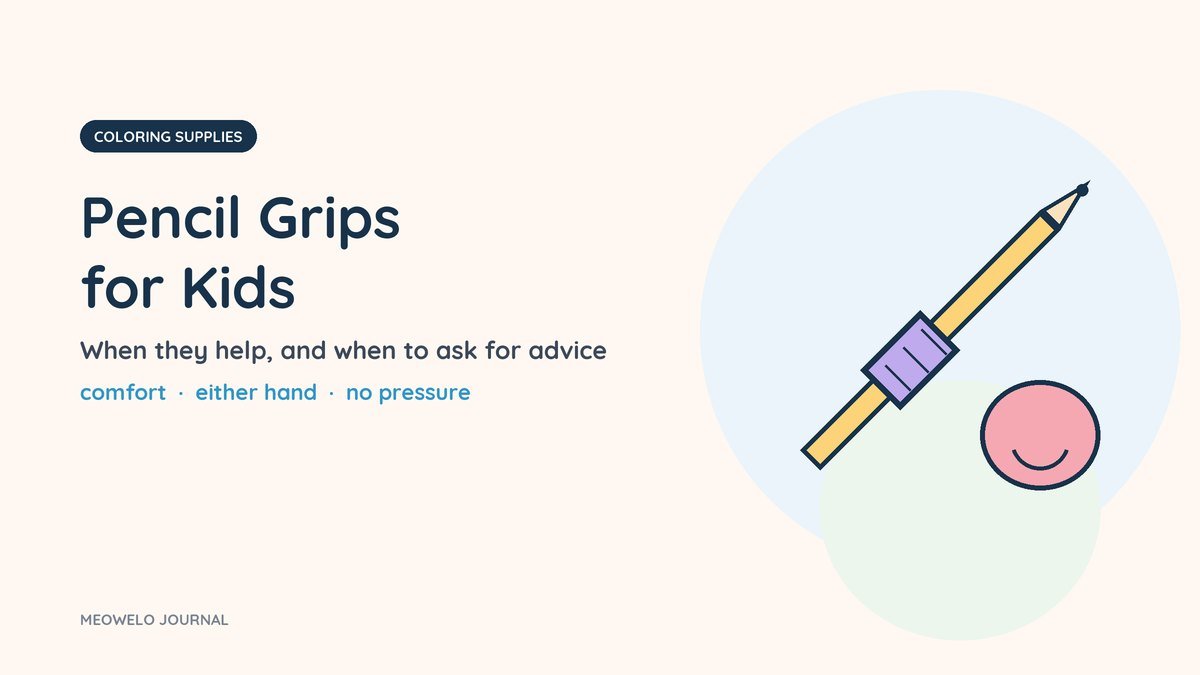
A pencil grip is a soft sleeve that slides onto a pencil and gives fingers a place to rest. For some children it makes holding a pencil or colored pencil more comfortable, especially during long coloring or writing sessions. It's a simple, inexpensive thing to try. It isn't a treatment, and if a child's grip seems painful or they avoid drawing altogether, it's worth asking their teacher or an occupational therapist.
Below: what grips do, signs a child might like one, how to introduce it, and other easy ways to make holding a pencil comfortable.
Affiliate disclosure. Some links below go to Amazon, and Meowelo may earn a commission if you buy through them, at no extra cost to you. As an Amazon Associate I earn from qualifying purchases. Amazon does not sponsor or endorse Meowelo. We list supplies that suit these books, and say what each one is not good for too. Full disclosure.
Signs a child might like a grip
- They squeeze the pencil very tightly, with white knuckles.
- Their hand gets tired or sore after a few minutes.
- Their fingers slide down towards the point.
- They change how they hold the pencil a lot.
None of these is a problem on its own. Many children hold pencils in unusual ways and color beautifully.
How to introduce a grip
- Put it on one or two favorite pencils, not all of them.
- Show where the fingers go once, then let them try it while coloring something fun.
- Let them choose: if they take it off, that's fine. Try again another week, or not at all.
- For left-handed children, choose a grip made for either hand.
Other ways to make holding easier
| Try | Why it helps |
|---|---|
| Short pencils or broken crayons | Short tools naturally encourage a fingertip hold |
| Thicker or triangular pencils | Easier to hold without squeezing |
| Coloring on a slope | A book or clipboard on a slight angle changes the wrist position |
| Short breaks | Shake hands out, then carry on |
| Hand-strength play | Play dough, clothes pegs and tearing paper |
Our guide to coloring and fine motor skills has more playful ideas.
When to ask for advice
If coloring or writing is painful, if a child avoids it, or if you're simply unsure, a teacher or occupational therapist can look at how they hold a pencil and suggest what fits them. A grip from a shop is a comfort tool, not a substitute for that advice.
Instead of
Hold it properly.
Try
Does your hand feel comfy? Want to try this squishy grip on your favorite pencil?
Types of grips, and who they suit
| Type | What it is | Often suits |
|---|---|---|
| Soft sleeve | A cushioned tube with finger hollows | Children who squeeze or tire quickly |
| Triangular grip | A three-sided shape that guides the fingers | Children whose fingers wander |
| Triangular pencils | The pencil itself is three-sided, no add-on | Children who dislike anything extra on the pencil |
| Thicker pencils | A wider barrel | Younger children, or hands that cramp |
If one type doesn't feel right, another often does. It's normal to try two or three before finding the favorite, or to find a child doesn't want one at all.
A two-week trial
- Week 1: put a grip on one favorite pencil and leave it in the pencil case. Don't mention it again.
- Notice: does your child pick that pencil? Do they color longer before shaking out their hand?
- Week 2: if they like it, add one to a second pencil. If they've been avoiding it, take it off and try a different type, or a thicker pencil instead.
- Decide together: ask "Does it feel comfy?" and go with the answer.
Comfort beyond the grip
- Seat and table height: feet flat, elbows resting comfortably on the table.
- The other hand: holding the paper steady takes strain off the coloring hand.
- Lighter pressure: layering color instead of pressing hard (see filling big areas) saves both hands and pencils.
What teachers often notice
Teachers see a lot of hands, and they often spot small things parents miss: a child who rests their head on their arm while writing, who switches hands, or who stops after a line or two. If you're unsure whether a grip would help, ask your child's teacher what they see during writing time. They may suggest trying one at school too, so the pencil feels the same everywhere.
Consistency matters more than the exact grip: one comfortable grip used at home and school is better than a different one in every pencil case. And if a teacher or occupational therapist has already suggested a specific grip, use that one; it was chosen for your child's hand.
Finally, remember that coloring itself is good practice. Short, enjoyable sessions with crayons and pencils build the same hand strength that makes holding a pencil easier, without anyone calling it practice.
Comfort is the goal. If your child colors happily for twenty minutes without shaking out their hand, their hold is working, whatever it looks like. Grips, thicker pencils and breaks are tools to make that easier, not rules. And if anything seems to hurt, a teacher or occupational therapist is the right person to ask.
Questions parents ask
Do pencil grips help kids?
What age are pencil grips for?
Do pencil grips work for left-handed children?
When should I worry about my child's pencil grip?
The one thing to remember
A grip is a small comfort to offer, not a rule. Comfort first, and ask for advice if something seems to hurt.


Conversation
Join the conversation
Tips, questions and stories from other grown-ups. A person reads every comment before it goes live.
No comments yet. What has worked at your house? Your story might be exactly what another parent needs tonight.