
This plan uses the twelve free Meowelo story printables, one a week, for a gentle 12-week rhythm: read the story moment on Monday, notice and color it midweek, and tell or write what happens next on Friday. Each week has a simple theme to talk about. It takes about 15 minutes a day, works for one child or siblings together, and costs nothing beyond paper.
Below: the weekly rhythm, the twelve weeks, and extensions for older children.
The weekly rhythm
| Day | Step | About |
|---|---|---|
| Monday | Read the story moment aloud | 10 min |
| Tuesday | Notice: list five details in the picture | 10 min |
| Wednesday | Color the scene | 20 min |
| Thursday | Talk about the week's theme | 10 min |
| Friday | Tell or write "what happens next" | 15 min |
The twelve weeks
| Week | Printable | Theme |
|---|---|---|
| 1 | Lunai and the Quiet Moon | Noticing small things |
| 2 | Naeli's Growing Garden | Growing and needing more room |
| 3 | Pico and the First Tree | Finding hidden doorways |
| 4 | The Secret Moon Pond | Looking closely |
| 5 | Myro and Cheddo Build a Home | Building together |
| 6 | Rinwa and the Crooked Stars | Fixing and trying again |
| 7 | The Rainbow Kite | Turning a tangle into a game |
| 8 | Myro's Surprise Picnic | Surprises and sharing |
| 9 | Cheddo's Little Basket | Collecting small discoveries |
| 10 | One Lantern at a Time | Big jobs, small steps |
| 11 | Myro's Unfinished Map | Making room for new places |
| 12 | Home Under the Stars | Coming home and remembering |
A short description of each is in our guide to the twelve free printables.
Extensions by age
- 6–7: tell the "what next" out loud; a grown-up writes one sentence for them (more ideas in helping a reluctant reader).
- 8–9: write three sentences, with a drawing.
- 10–12: write a half-page continuation, or make a six-panel comic (see story prompts).
Coloring and reading support each other well; see coloring and reading and reading aloud to older kids.
Keep the finished pages
A folder with all twelve colored scenes and stories makes a lovely end-of-term book. Our guide to keeping kids' artwork has ideas.
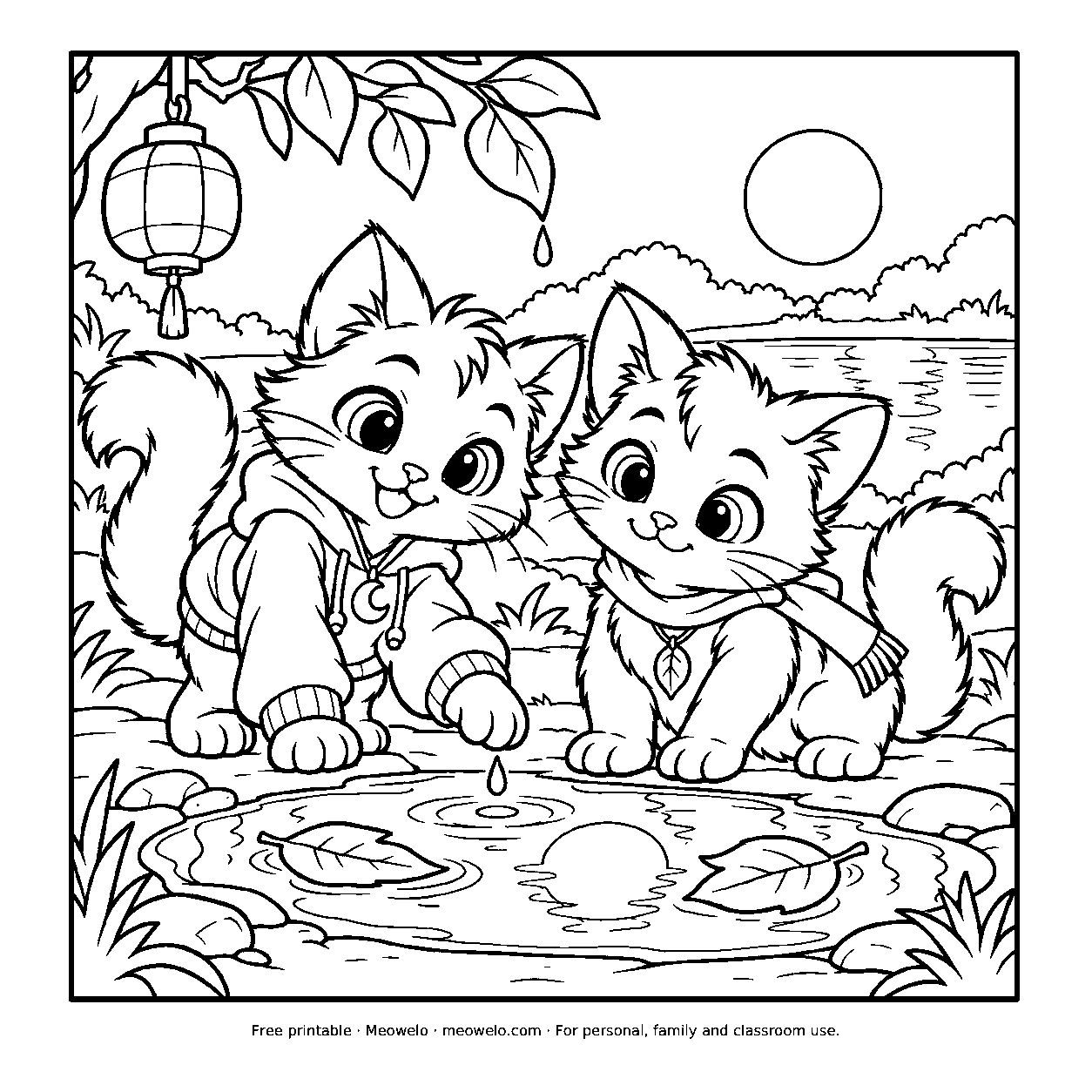
Lunai and the Quiet Moon
Lunai and Myro find a second moon in a puddle beside the lantern path.
Print it freeTips for making it stick
- Same time each day: right after breakfast or before lunch works well for many families.
- Short is fine: ten focused minutes beat forty reluctant ones.
- Let the child lead the talk on Thursday; your job is to ask and listen.
- Miss a day? Carry on. The plan bends; the rhythm is what matters.
Working with siblings
Everyone reads the same story moment together, then each child works at their own level: the youngest tells, the middle one writes a few sentences, the oldest makes a comic. Comparing on Friday is often the best part of the week (see coloring with siblings).
What children practice each week
| Step | Skills |
|---|---|
| Read | Listening, vocabulary, fluency (when they read aloud) |
| Notice | Close looking, describing, finding evidence in a picture |
| Color | Fine motor control, choices, focus |
| Talk | Sharing opinions, listening to others, feelings words |
| Tell or write | Sequencing, prediction, sentence building |
None of this needs to be named to the child. To them it's a story and a picture; the learning happens along the way.
Thursday conversation starters
- "Which friend in the story are you most like this week?"
- "Was there a moment someone felt unsure? What helped?"
- "If you could add one thing to the picture, what would it be?"
- "What would you have done if you were there?"
Keep a simple record
If you keep homeschool records, the folder of twelve colored scenes and stories is a ready-made portfolio. Add the date to each page and one line about what your child said or wrote. At the end of twelve weeks you have evidence of reading, writing, discussion and art in one place, and a lovely keepsake.
For printing tips, see how to print coloring pages.
After the twelve weeks
When the plan ends, you can run it again with a twist: the same twelve printables, but this time your child chooses the theme for each week, or writes a whole new ending instead of "what happens next". Children notice different details the second time, and comparing their first and second pages for the same story is a lovely way to see how much they've grown.
You can also use the rhythm with any story you love: read on Monday, notice on Tuesday, color or draw on Wednesday, talk on Thursday, tell on Friday. The structure is what makes it easy to keep going.
If your child is a reluctant reader, keep the reading part short and let them listen more than read; see helping a reluctant reader for gentle ideas.
Many families find the plan works best when it's predictable but flexible: the same five steps, in roughly the same order, at a time of day that suits your family. If a week runs long, stretch it; if your child is gripped by a story, spend an extra day on it. The printables don't expire, and following their interest is part of what makes homeschooling work.
Questions parents ask
Can I use Meowelo free printables for homeschool?
How long does this plan take each day?
What ages is the plan for?
Do I need the books for this plan?
The one thing to remember
One story a week, a little each day: read, notice, color, tell. Twelve weeks later, you have a book of your child's own.


Conversation
Join the conversation
Tips, questions and stories from other grown-ups. A person reads every comment before it goes live.
No comments yet. What has worked at your house? Your story might be exactly what another parent needs tonight.