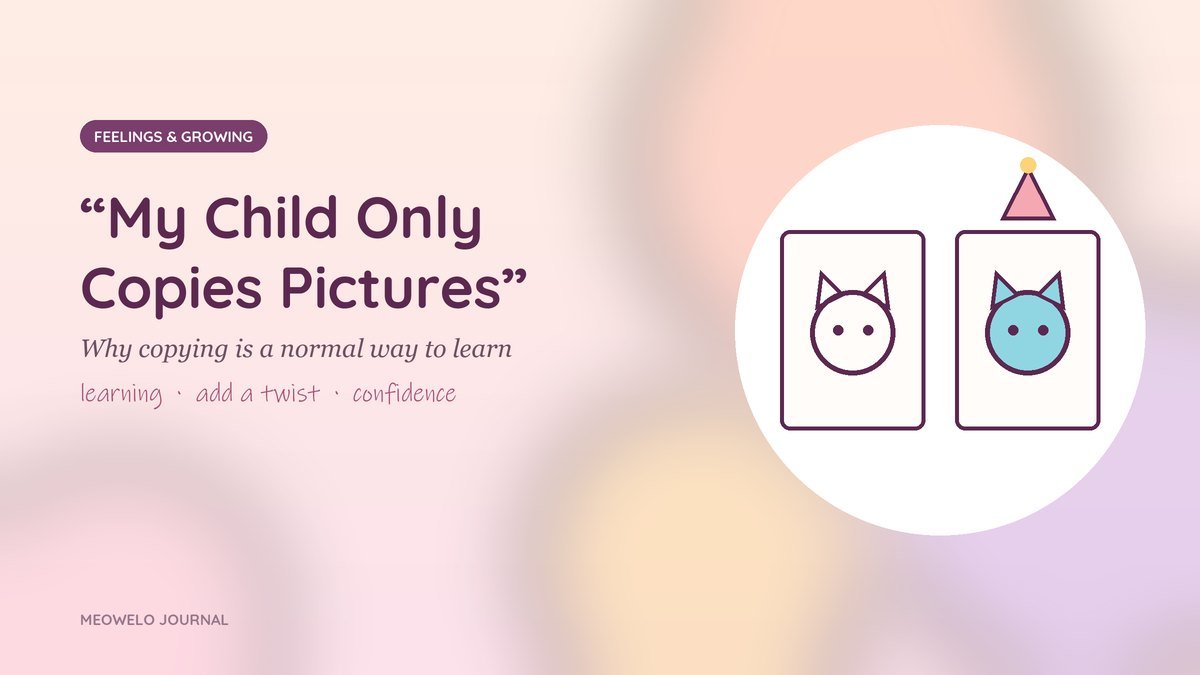
Yes, it's OK. Copying pictures is one of the most common ways children learn to draw. Copying a favorite character teaches shapes, proportions and how lines make a face or a pose. Many artists learned this way. Imagination usually grows alongside it, and you can encourage it gently by inviting a small change of their own rather than asking them to stop copying.
Below: why copying helps, when to add a twist, and what to say.
Why copying helps
- Breaks pictures into shapes: a head is a circle, a body an oval.
- Trains the eye: children notice where things sit and how big they are.
- Builds confidence: a drawing that "looks right" feels great.
- Collects a visual vocabulary they'll later mix into their own pictures.
Gentle ways to add a twist
| Twist | Example |
|---|---|
| New place | Draw the character at your house, or at the beach |
| New outfit | Give them a winter coat or a party hat |
| New friend | Invent a sidekick for them |
| New moment | What are they doing the next day? |
| New colors | Color them completely differently |
Coloring pages work the same way: the lines are given and the choices are theirs. That's why we never tell children which color is right (see color choices).
Instead of
Why don't you draw something of your own?
Try
That looks just like him! Where do you think he'd go on holiday?
When to think a little more
If a child only copies because they say their own drawings are "bad", the worry isn't copying, it's confidence. Our guides to "I can't draw" and perfectionism in young artists can help, along with how to praise kids' art.
A note on sharing
Copying for practice at home is fine. If a child wants to sell or publicly post a copy of someone else's character, that's a good moment to talk about artists' work belonging to them, and about how fun it is to invent your own.
Copying as a skill: a simple practice
- Look first: find the big shapes (circle head, oval body).
- Draw the big shapes lightly.
- Add the details one at a time.
- Compare: what came out well? What would you change next time?
Done this way, copying trains looking as much as drawing. That's the same skill children use when they notice details in a picture book.
Turning copies into stories
Once a child can draw a favorite character, invite them to put it into a story of their own: three boxes, beginning, middle and end. Our story prompts for kids have plenty of starting points.
What children learn from copying
| Skill | How copying builds it |
|---|---|
| Looking closely | They have to notice where things are and how big |
| Breaking things into shapes | A character becomes circles, ovals and lines |
| Line confidence | Repeating a drawing makes their lines steadier |
| Patience | A careful copy takes longer than a scribble |
| A visual library | Ears, eyes and poses they'll reuse in their own ideas |
From copy to original in four steps
- Copy it exactly: the favorite character, as close as they can.
- Change one thing: new colors, a hat, a different expression.
- Change the scene: put the character somewhere new, with their own background.
- Invent a friend: a brand-new character in the same style.
There's no schedule for these steps. Some children move through them in a week, others stay happily at step one for months. The point is that each step is offered, never forced.
Coloring pages are copying with a head start
A coloring page gives the lines and leaves every choice of color to the child, which is a gentle bridge between copying and creating. Many children who only copy pictures relax when they color, because the "is it right?" question disappears: there's no right color.

The Meowelo Companion
The free Meowelo Companion shows one picture colored four different ways, and none of them is the right one. Plus 10 printable gifts for subscribers.
Get the free guideWhen copying turns into style
Many children copy one artist or one cartoon for a long time, then slowly start mixing in their own habits: bigger eyes, rounder shapes, a favorite color. That mix is the beginning of a personal style. You'll often see it first in small details, like the way they draw hands or trees, before it shows in whole pictures.
Point it out when you notice it: "Your trees always have that curly top now. That's yours." Children rarely notice their own style until someone names it, and hearing it gives them a quiet confidence to keep going.
If your child enjoys copying characters, a sketchbook just for "favorite characters" can be a lovely record. Date each page, and in a year you'll both be able to see how much their drawing has grown.
Above all, keep drawing time enjoyable. A child who loves drawing will find their own way to originality in time, and copying is often the road that gets them there. Many illustrators say they started by copying comics and picture books for hours. Treat your child's copies with the same interest you'd give an original, and ask what they noticed while drawing it.
Questions parents ask
Is it bad if my child copies drawings?
Does copying stop children being creative?
How do I encourage original drawings?
When should I worry about copying?
The one thing to remember
Copying is how a lot of drawing begins. Enjoy the copies, and every so often ask, "What would happen next?"


Conversation
Join the conversation
Tips, questions and stories from other grown-ups. A person reads every comment before it goes live.
No comments yet. What has worked at your house? Your story might be exactly what another parent needs tonight.