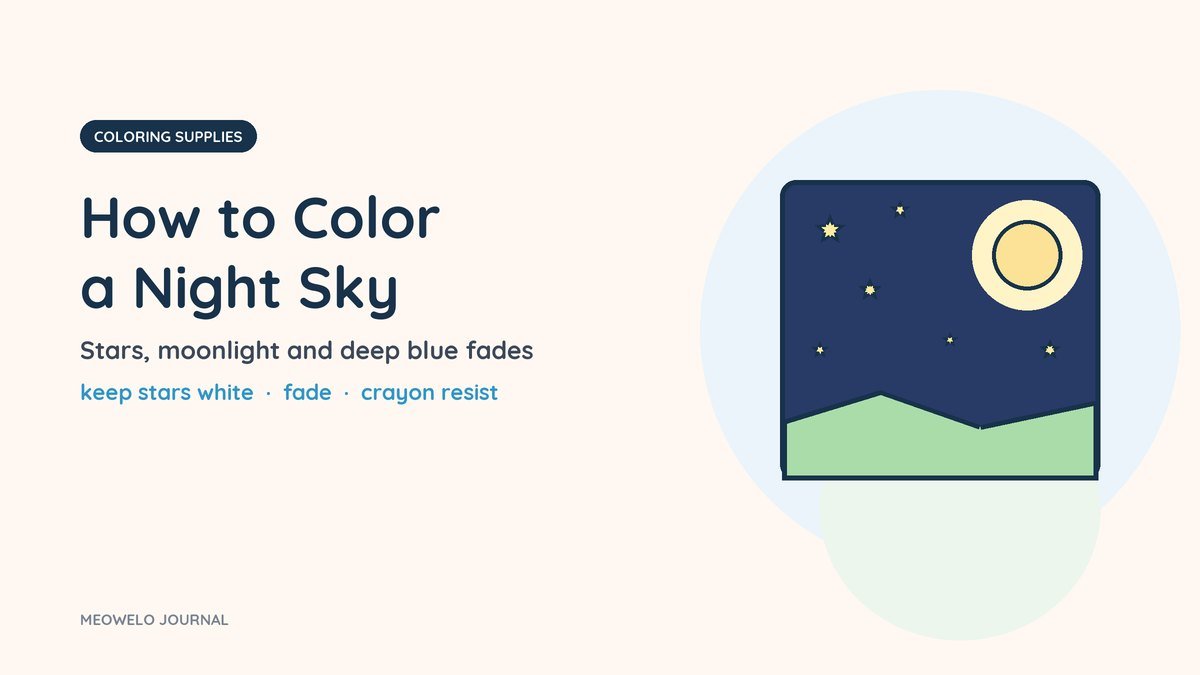
To color a night sky, keep the stars and moon white first, then fill the sky from a lighter blue near the horizon to a deep blue or purple at the top, and finish with a glow around the moon. The trick is protecting the light parts before the dark goes on: color around the stars, press them in with a white crayon, or draw them in after with a gel pen or metallic marker. A night sky doesn't need black at all; deep blues and purples look richer.
Below: five ways to do it, from the simplest to a little "magic" trick, and the tools that suit each.
Affiliate disclosure. Some links below go to Amazon, and Meowelo may earn a commission if you buy through them, at no extra cost to you. As an Amazon Associate I earn from qualifying purchases. Amazon does not sponsor or endorse Meowelo. We list supplies that suit these books, and say what each one is not good for too. Full disclosure.
1. The simple fill (ages 6+)
Color carefully around each star and the moon, then fill the rest of the sky in one dark blue. Pressing lightly first and adding a second layer gives an even color without sore hands. Our guide to filling big areas has the strokes that keep it smooth.
2. The two-blue fade (ages 7+)
- Color the bottom third of the sky in a lighter blue.
- Color the top third in a deep blue or purple.
- Where they meet, layer both lightly until there's no line.
This is the same idea as a sunset fade, explained step by step in how to blend with crayons.
3. A glowing moon
Leave the moon white or pale yellow, then color a soft ring of very light yellow or cream around it before the blue begins. The ring makes the moon look like it's shining. A few lighter clouds near the moon catch the light too.
4. Stars that sparkle
- Leave them white: color around them carefully.
- Add them last: a white gel pen, a metallic marker or a metallic crayon on top of the dark blue.
- Different sizes: a few big stars and many tiny dots look more like a real sky.
Metallic colors show best on dark areas; our guide to metallic crayons and markers covers them.
5. The crayon-resist trick (ages 8+)
- Print the page on heavier paper.
- Press firmly with a white or yellow crayon on the stars and the moon.
- Paint the whole sky with dark blue watercolor.
- Watch the stars appear: the wax keeps the paint off.
Children love this one. Thin printer paper wrinkles when wet, so use heavier paper (see how to print coloring pages).
Which tool for which sky
| Look | Tool |
|---|---|
| Smooth, deep blue | Colored pencils in layers |
| Fast and bold | Broad washable markers (on heavier paper) |
| Soft and textured | Crayons, or the side of a wax block |
| Magic stars | White crayon plus watercolor |
| Sparkle | Metallic crayons or markers on top |
Tools for night skies
| Pick | Best for | Good to know | Buy |
|---|---|---|---|
 Metallic shimmer for stars and moonsCrayola Metallic Crayons, 16 Count |
Beautiful on moons, lanterns and stars | Less coverage than classic crayons on large areas | $11.89 on Amazon.com Price as of DetailsProduct prices and availability are accurate as of the date/time indicated and are subject to change. Any price and availability information displayed on Amazon.com at the time of purchase will apply to the purchase of this product. |
 Watercolor for the resist trickCrayola Washable Watercolor Paint Set for Kids |
Washable formula for easier clean-up | Needs thicker paper: too wet for thin book pages | $8.49 on Amazon.com Price as of DetailsProduct prices and availability are accurate as of the date/time indicated and are subject to change. Any price and availability information displayed on Amazon.com at the time of purchase will apply to the purchase of this product. |
 Soft pencils for smooth fadesCrayola Colored Pencils, 36 Count |
36 shades, including useful in-betweens | Needs a sharpener eventually | $6.57 on Amazon.com Price as of DetailsProduct prices and availability are accurate as of the date/time indicated and are subject to change. Any price and availability information displayed on Amazon.com at the time of purchase will apply to the purchase of this product. |
Amazon shows the current price and delivery. Tap any name for our full write-up, including what it’s not good for.
Instead of
Night skies are black.
Try
Which blue do you think the sky is tonight? Let's look outside.
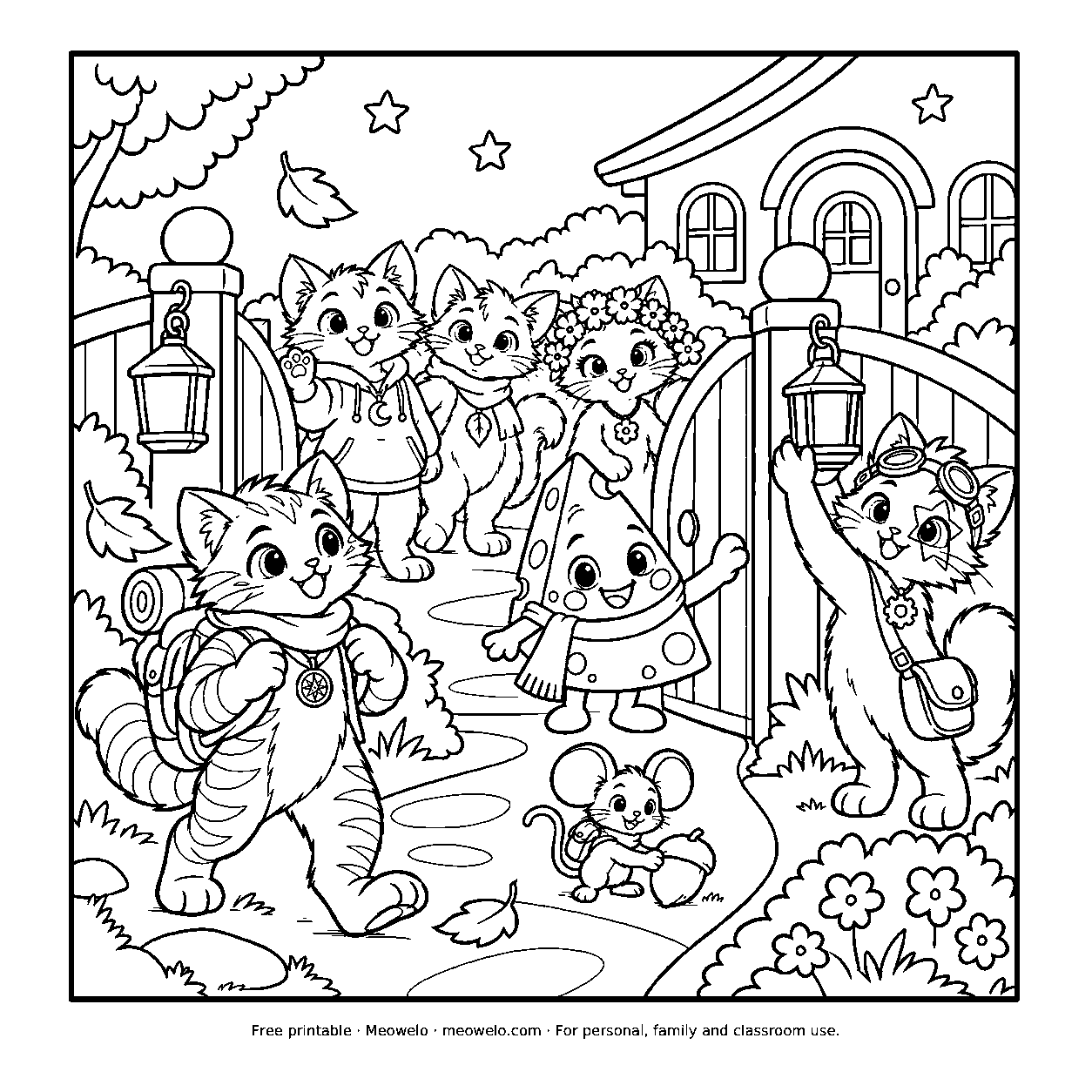
Home Under the Stars
Seven friends arrive home with muddy paws, full pockets and one last acorn.
Print it freeNight skies by mood
| Mood | Colors | Details |
|---|---|---|
| Calm and sleepy | Navy fading to soft purple | A few small stars, a pale moon |
| Magical | Indigo, purple and a touch of pink | Lots of stars, a big glowing moon |
| Stormy | Dark gray-blue | Clouds over the moon, no stars |
| Snowy | Deep blue with white snowflakes | Light from windows below |
Lights below the sky
A night sky looks even more magical with small lights underneath: lit windows, lanterns along a path, a campfire. Leave them white or pale yellow, and color a soft yellow glow around each one. The contrast between warm lights and a cool sky is what makes evening scenes feel cozy.
Shimmer helps too: a touch of gold on the lanterns (see metallic crayons and markers).
A night sky for every season
Spring nights can have pale green hills and a soft violet sky; summer nights fireflies (tiny yellow dots with a pale glow); autumn nights a big orange harvest moon low on the horizon; and winter nights snow on the roofs and a crisp, deep-blue sky full of stars.
Whatever the season, the same three steps apply: protect the lights first, fade the sky from lighter to darker, and finish with a glow around the brightest things. Once your child knows them, they can color any evening scene with confidence, from a lantern walk to a campfire, and add their own details, like a shooting star or a sleepy owl on a branch.
Questions parents ask
How do you color a night sky with colored pencils?
How do you keep stars white when coloring?
Should a night sky be black?
What is the crayon-resist technique?
The one thing to remember
Save the light first, then let the dark come in around it. Stars, a moon and a deep blue fade are all a night sky needs, in whatever colors your child chooses.


Conversation
Join the conversation
Tips, questions and stories from other grown-ups. A person reads every comment before it goes live.
No comments yet. What has worked at your house? Your story might be exactly what another parent needs tonight.