Classic wax crayons are better for big areas, side-of-the-crayon shading, rubbings and blending; twistable crayons are better for children who press hard, peel every wrapper or color on the go. Neither is better overall. Many families end up with one box of each: classic crayons on the table at home, twist-ups in the travel pouch.
Below: what actually differs between the two, a side-by-side table, which suits which kind of child, a note on twistable colored pencils, and how to make either kind last.
Affiliate disclosure. Some links below go to Amazon, and Meowelo may earn a commission if you buy through them, at no extra cost to you. As an Amazon Associate I earn from qualifying purchases. Amazon does not sponsor or endorse Meowelo. We list supplies that suit these books, and say what each one is not good for too. Full disclosure.
What's actually different
A classic crayon is a stick of colored wax in a paper wrapper. You color with the tip, or peel the paper and use the long side to cover a large area quickly. When the tip goes blunt you keep going, or sharpen it in the crayon sharpener on the box.
A twistable crayon sits inside a clear plastic barrel. You twist the end and a little more crayon rises out of the top. There's no paper to peel and nothing to sharpen, and because only a short piece sticks out, it is much harder to snap. The trade-off: you can only ever color with the tip, and once it's used up the empty barrel is thrown away.
That one difference, tip-only versus tip-and-side, explains most of what each kind is good and bad at.
Side by side
| Twistable crayons | Classic crayons | |
|---|---|---|
| Snapping | Rarely snap | Snap easily under heavy pressure |
| Peeling wrappers | Nothing to peel | Wrappers get peeled, torn and scattered |
| Sharpening | Never needed | Optional, with a crayon sharpener |
| Big areas | Slower: tip only | Fast: peel and use the side |
| Rubbings (leaves, coins, bark) | Hard to do well | Ideal: a peeled crayon on its side |
| Blending colors | Possible with the tip, in small areas | Easier: layer, then blend with the side |
| Crayon resist with paint | Not the usual choice | The classic method |
| Travel and car trips | Excellent: clean, nothing to lose | Fine, but stubs and wrappers get everywhere |
| Waste | A plastic barrel per crayon | A paper wrapper per crayon |
Twist-up or classic, side by side
| Pick | Best for | Good to know | Buy |
|---|---|---|---|
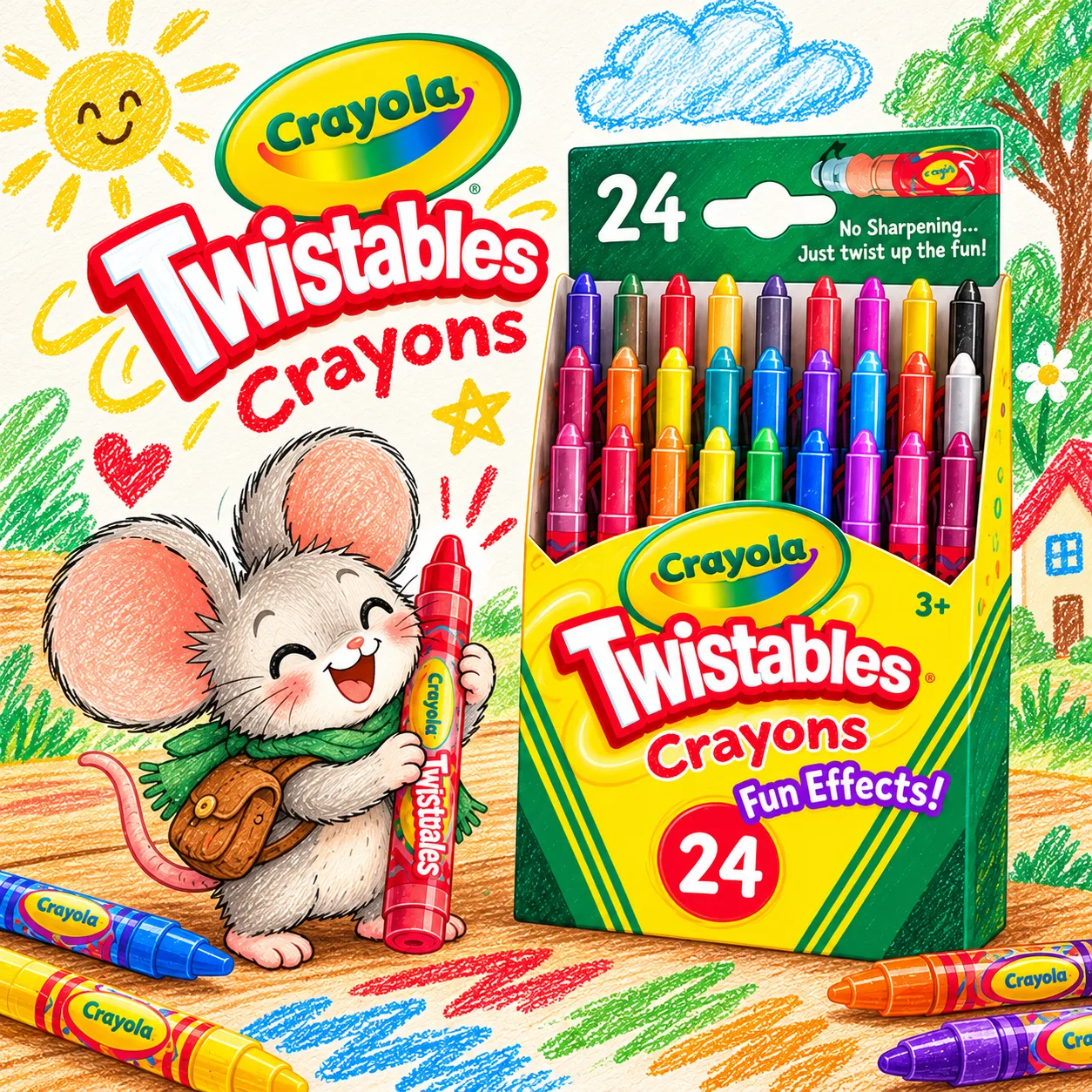 Twist-up: no peeling, no sharpeningCrayola Twistables Crayons for Kids, 24 Count |
Very hard to snap, even for heavy pressers | Color is slightly softer than classic wax | $8.77 on Amazon.com Price as of DetailsProduct prices and availability are accurate as of the date/time indicated and are subject to change. Any price and availability information displayed on Amazon.com at the time of purchase will apply to the purchase of this product. |
 Classic wax crayons, washableCrayola Ultra-Clean Washable Crayons, 16 Colors |
Much easier to clean off walls and surfaces | 16 colors rather than 24 | $8.94 on Amazon.com Price as of DetailsProduct prices and availability are accurate as of the date/time indicated and are subject to change. Any price and availability information displayed on Amazon.com at the time of purchase will apply to the purchase of this product. |
Amazon shows the current price and delivery. Tap any name for our full write-up, including what it’s not good for.
Which suits which child
The heavy presser who snaps everything
If the crayon box is mostly stubs, twistables are the simple fix: with only a short tip exposed, there's little to break. It also helps to know why it happens; pressing hard is very common while hand control is still developing, and our article on why kids snap crayons explains the rest. Teach the "twist a little" rule from day one, though, or the twistable tips will snap too.
The wrapper peeler
Some children peel every wrapper the moment the box opens, which leaves bare crayons that break easily and paper bits on the floor. Twistables simply remove the temptation. Alternatively, accept the peeling and use it: a peeled crayon is exactly what you need for rubbings and big areas.
The big-picture colorer
Children who like to fill whole skies, seas and backgrounds will find twistables slow. A classic crayon on its side covers a page in a few strokes, and layering two colors this way gives soft, even backgrounds. The techniques are in how to fill big areas when coloring and how to blend with crayons.
The texture and rubbing fan
Leaf rubbings, bark rubbings, coin rubbings and wax-resist paintings all need a classic crayon, ideally peeled and used flat. If your child loves texture, keep a box of classic crayons even if twistables are their everyday choice. Ideas for texture on any page are in how to color fur, wood, water and stone.
The traveler
For car trips, restaurants, waiting rooms and grandparents' houses, twistables are hard to beat: no wrappers, no shavings, no sharpener, and fewer broken pieces under the car seat. A small set in a pouch with a clipboard and a few printed pages makes a complete kit; see a travel art kit for kids.
The detail lover (often 9 to 12)
Children who want fine lines and small details usually outgrow both kinds of crayon for that job and move to colored pencils. If they like the twist-up idea, twistable colored pencils work the same way: a pencil lead in a plastic barrel, no sharpener needed. They give a finer line than crayons, though not as sharp as a freshly sharpened wooden pencil. The bigger picture is in colored pencils for kids and crayons vs colored pencils vs markers.
Crayola Twistables Colored Pencils, 50 Count
The big no-sharpen set: 50 twist-up colored pencils for keen colorers and families who share.
$14.14 on Amazon.comSave 6%
Details
Product prices and availability are accurate as of the date/time indicated and are subject to change. Any price and availability information displayed on Amazon.com at the time of purchase will apply to the purchase of this product.What about size?
Most twistable crayons are a regular, slim size, which suits most children of 6 to 12. Younger children or those who find a slim crayon hard to hold sometimes prefer large crayons, which are also very hard to break. Our comparison of large vs regular crayons covers when each size suits.
Safety: the same rule for both
Whichever kind you choose, check the box says non-toxic and carries the ACMI AP seal, which is awarded after a toxicologist has reviewed the product; ACMI recommends looking for it on supplies for children in sixth grade or younger. The seal is printed on the packaging, so check each box, twistable or classic. More in our guide to non-toxic art supplies.
How to make either kind last
- Twistables: twist a few millimetres at a time. A long tip sticking out snaps just like a classic crayon.
- Both: keep them out of a hot car, where any crayon softens and bends.
- Classic: keep the wrapper on for everyday coloring; it holds the crayon together. Peel only the ones you use for rubbings.
- Classic: keep the stubs. Short pieces are perfect for rubbings and side-shading, and broken crayons still color perfectly well.
- Both: store them flat in a tray or tin rather than loose in a deep bag, where heavier things press on them.
For younger and older colorers
Ages 6 to 8: twistables are often the less frustrating choice for everyday coloring, especially for children who press hard, with a box of classic crayons kept for rubbings and big art projects. Ages 9 to 12: many children this age use crayons mainly for backgrounds, rubbings and resist paintings, where classic crayons win, and move to colored pencils (twistable or wooden) for detail.
Questions parents ask
Are twistable crayons better than regular crayons?
Do twistable crayons break?
Can you do crayon rubbings with twistable crayons?
Do twistable crayons need sharpening?
The one thing to remember
Twistables are the tidy, unbreakable everyday crayon; classic crayons are the flexible art-project crayon. Match the box to how your child colors, and if they do both, keep a box of each.


Conversation
Join the conversation
Tips, questions and stories from other grown-ups. A person reads every comment before it goes live.
No comments yet. What has worked at your house? Your story might be exactly what another parent needs tonight.